

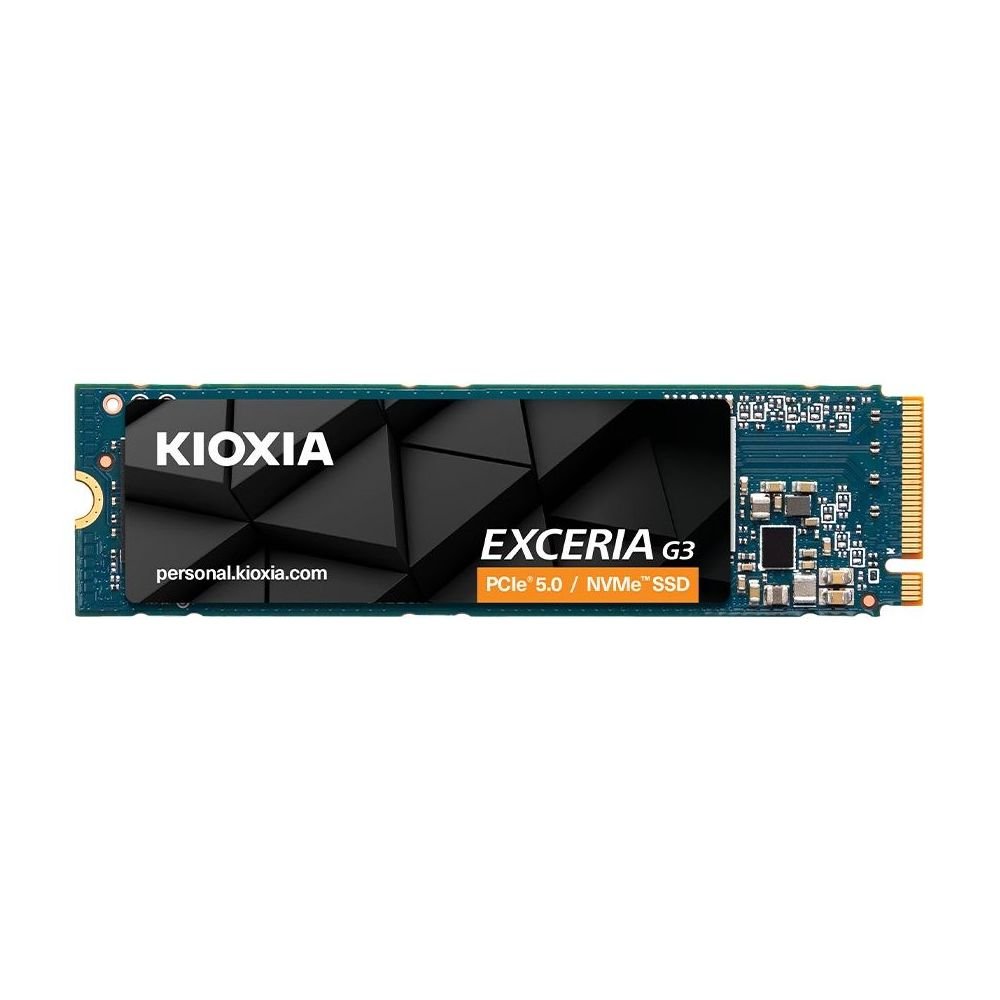
Kioxia Exceria G3 M.2 PCIe5x4 1TB SSD
R3,725.00 inc. VAT
Kioxia’s entry point into PCIe Gen 5 storage — built on Kioxia’s own BiCS FLASH™ 3D NAND with the PCIe 5.0 x4 interface and NVMe 2.0c protocol. The Exceria G3 delivers sequential read speeds of up to 10,000MB/s and write speeds of up to 8,900MB/s for the 1TB model, with up to 1,300,000 read and 1,450,000 write IOPS. Kioxia’s first consumer PCIe 5 drive — and one of the most accessible ways into Gen 5 performance available today.
In stock
Description
The First Step Into PCIe 5.0
The EXCERIA G3 SSD series, an entry-level model supporting PCIe 5.0, takes performance to the next level with up to 10,000MB/s of sequential read speed — not only accelerating everyday PC tasks but also supporting AI applications and helping build a comfortable gaming environment. PCIe Gen 5 doubles the available bandwidth of Gen 4, and the Exceria G3 is Kioxia’s deliberate entry point into that tier — priced to make Gen 5 accessible rather than reserved for enthusiast builds. It is fully backwards compatible with PCIe 4.0 platforms, where it will operate at Gen 4 speeds.
BiCS FLASH™ — Kioxia’s Own NAND, QLC at This Tier
Each Exceria G3 SSD is built with Kioxia BiCS FLASH™ — a vertically stacked cell structure delivering a cutting-edge storage experience. At the 1TB capacity, the Exceria G3 uses QLC (Quad-Level Cell) NAND — four bits per cell, which enables the high density needed to keep a PCIe 5 drive at an accessible price point. QLC NAND has lower raw write endurance than TLC, which is worth knowing upfront. For read-heavy workloads — gaming, content consumption, OS and application loading — this is largely a non-issue. For sustained large write workloads, the SLC cache will eventually exhaust and write speeds will taper. As the inventor of NAND flash, Kioxia’s BiCS FLASH manufacturing and quality control standards are well-established — this is not generic OEM flash.
NVMe 2.0c — Lower Latency by Design
Utilising NVMe 2.0c technology, the Exceria G3 SSDs reduce latency in your system’s I/O path between your SSD and CPU, resulting in smooth and responsive performance. NVMe 2.0c is the latest revision of the NVMe standard — an incremental but meaningful improvement in queue management and command processing efficiency over the NVMe 1.4 found on most Gen 4 drives.
Innovative Thermal Label — No Separate Heatsink Required
EXCERIA G3 SSDs feature innovative product labels to enhance heat dissipation for advanced performance stability. Rather than a traditional aluminium heatsink, the Exceria G3 uses a thermally active label that dissipates heat across the drive surface. This keeps the drive’s profile slim — at just 2.38mm height — and avoids the clearance issues that bulkier heatsinks can cause in compact builds and laptops. A motherboard-integrated M.2 heatsink is recommended for sustained PCIe 5 workloads in desktop systems.
SSD Utility — Health Monitoring and Percentage Life Left
SSD Utility management software was designed to help your Kioxia drive thrive, putting you in control of maintenance, monitoring, and more — including checking Percentage Life Left using the health gauge. Kioxia’s warranty is tied to Percentage Life Left reaching zero, making the SSD Utility’s health gauge a directly useful tool for tracking remaining drive life.
⚠️ PCIe Gen 5 slot required for full performance — the Exceria G3 requires a PCIe 5.0 M.2 slot for its rated 10,000MB/s read speed. It is backwards compatible with PCIe 4.0 at approximately half the rated sequential speeds (~5,000MB/s read). PCIe Gen 5 M.2 slots are found on Intel 12th/13th/14th Gen and AMD Ryzen 7000-series platforms with appropriate motherboards — verify support before ordering.
⚠️ QLC NAND — important to understand — the Exceria G3 1TB uses QLC flash. Excellent for read-heavy workloads and everyday use; sustained heavy write workloads will see speed reduction once the SLC cache is exhausted. For write-intensive use cases, consider a TLC-based Gen 4 alternative.
ℹ️ Thermal management — the Exceria G3’s thermal label provides passive heat dissipation, but sustained PCIe 5 workloads generate significant heat. A motherboard M.2 heatsink is recommended for desktop builds where the drive will be pushed hard. Without active or passive heatsink supplementation, thermal throttling may occur during extended sequential writes.
ℹ️ TBW — Kioxia has not published a TBW figure for the Exceria G3 in easily accessible sources; the warranty is effective until the Percentage Life Left gauge reaches zero. Monitor drive health via the SSD Utility to track remaining endurance.
Key Highlights
- Capacity: 1TB
- Form Factor: M.2 2280 (single-sided)
- Interface: PCIe Gen 5 x4 / NVMe 2.0c (backwards compatible with PCIe Gen 4)
- Interface Speed: 128 GT/s
- Sequential Read/Write: Up to 10,000 / 8,900 MB/s
- Random Read/Write IOPS: Up to 1,300,000 / 1,450,000
- NAND: Kioxia BiCS FLASH™ QLC (in-house)
- DRAM Cache: None (SLC caching used)
- Thermal Management: Innovative thermally active product label
- Dimensions: 80.15 × 22.15 × 2.38mm
- Weight: 5.7g
- Protocol: NVMe 2.0c
- Software: Kioxia SSD Utility (download — health monitoring, Percentage Life Left gauge, firmware updates)
Proudly sold by the Ringwood Digital Store.
Reviews
There are no reviews yet.