

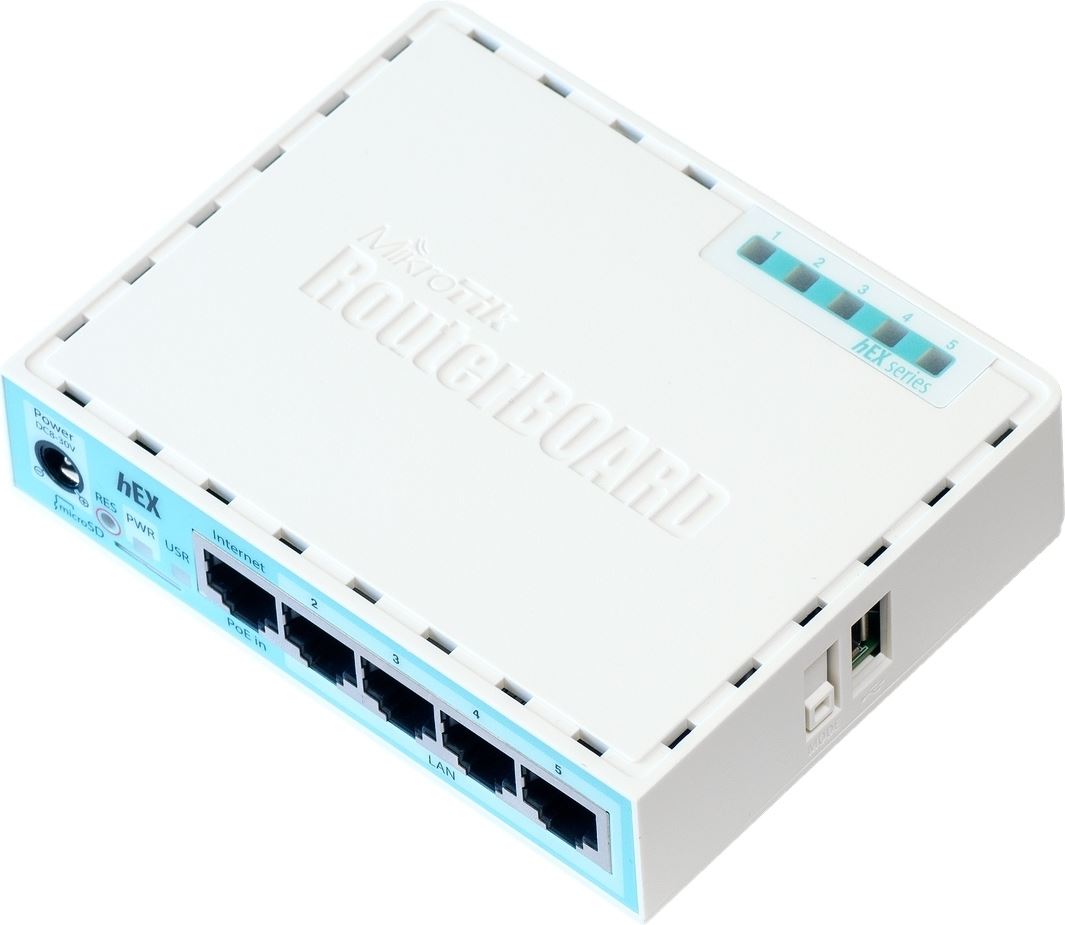
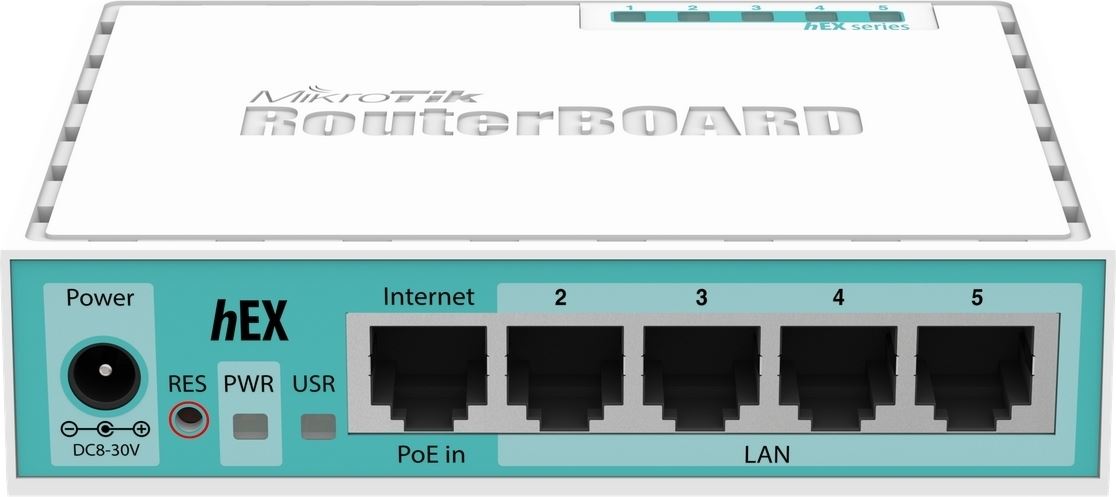
MikroTik RouterBOARD hEX 5 Gigabit Ethernet Router
R1,109.00 inc. VAT
The MikroTik hEX (RB750Gr3) is the Gigabit-capable step up from the hEX lite, fitting five Gigabit Ethernet ports, a dual-core 880 MHz MMIPS CPU, 256 MB RAM, hardware IPsec acceleration, USB, and a microSD slot into the same compact plastic desktop enclosure — all running RouterOS Level 4. It’s the natural upgrade for anyone who has outgrown the RB750r2’s 100 Mbps ports, or needs IPsec VPN performance beyond what a software-only implementation can deliver.
In stock
Description
Gigabit Throughout — the Key Upgrade Over the hEX lite
The most immediate difference between the RB750Gr3 and its sibling the RB750r2 (hEX lite) is Gigabit Ethernet. Five 10/100/1000 Mbps Gigabit ports give the hEX full-speed connectivity for modern broadband connections and internal networks — relevant for fibre connections above 100 Mbps, NAS access, inter-VLAN routing between Gigabit switches, or any scenario where the 100 Mbps ceiling of the hEX lite becomes the bottleneck.
Dual-Core CPU and Hardware IPsec
The MT7621A CPU runs at 880 MHz with 2 cores and 4 threads (MMIPS architecture), paired with 256 MB RAM. The practical payoff of the better CPU is hardware-accelerated IPsec: IPsec hardware encryption delivers approximately 470 Mbps throughput, making the RB750Gr3 a capable VPN gateway for site-to-site tunnels, road warrior VPN, or L2TP/IPsec connections without the CPU stalling under encryption load. For comparison, software-only IPsec on a 100 Mbps device like the hEX lite is constrained by both CPU and port speed simultaneously.
USB, microSD, and The Dude
A full-size USB port and microSD slot are included. The USB port accepts 3G/4G LTE modems for WAN failover, or USB storage for configuration backups and logging. The microSD slot provides improved read/write speed for database storage — specifically for The Dude server package, MikroTik’s network monitoring and management application. Running The Dude on the RB750Gr3 lets you monitor your entire network from this one small device without a separate server.
RouterOS L4 — Full Feature Set
RouterOS Level 4 is pre-installed and fully licensed. The complete feature set includes static and dynamic routing (OSPF, BGP, RIPv2), NAT, SRC-NAT/DST-NAT, firewall with connection tracking, VLAN (802.1Q), bridge, bonding, IPsec, OpenVPN, L2TP, PPTP, SSTP, MPLS, bandwidth queuing (HTB, FIFO, SFQ, PCQ), traffic shaping, Netwatch, scripting and scheduler, hotspot, DHCP server/client/relay, DNS cache, and PPPoE client/server. Free software updates are included for the life of the product or a minimum of five years from date of purchase.
Power Options and Extras
The RB750Gr3 accepts power via DC jack (8–30V) or passive PoE-in, with a maximum power consumption of 5W without attachments and 10W with USB devices attached. Additional on-board features include a PCB temperature monitor, voltage monitor, mode button, and a piezo beeper — the latter used by RouterOS for scripted alerts or status notifications.
Key Highlights
- CPU: MT7621A dual-core MMIPS @ 880 MHz | 4 threads
- RAM: 256 MB | Storage: 16 MB flash + microSD slot
- Ethernet ports: 5× Gigabit (10/100/1000 Mbps)
- Switch chip: MT7621A
- RouterOS: Level 4 (pre-installed, lifetime updates included)
- IPsec hardware acceleration: ~470 Mbps
- USB: 1× full-size USB Type-A (3G/4G modem, storage)
- microSD: 1× slot (Dude server, file storage)
- Power: DC jack 8–30V or passive PoE-in | Max 5W (10W with USB)
- Power adapter: Included
- Extras: PCB temp monitor, voltage monitor, mode button, beeper
- Dimensions: 113 × 89 × 28 mm | Weight: 175 g (approx.)
- Enclosure: Plastic desktop
- Architecture: MMIPS
Proudly sold by the Ringwood Digital Store.
Related products
-
- Networking, Routers
MikroTik hEX S (RBE60iUGS) 5-Port SFP Router
- R1,315.00 inc. VAT
- Add to basket
-
- Networking, Server Cabinets, Wall Mount
Cattex 6U 450 Deep Wall Mount Server Cabinet
- Price range: R1,489.00 through R1,545.00 inc. VAT
- Select options This product has multiple variants. The options may be chosen on the product page
-
- Networking, Server Cabinets, Wall Mount
Cattex 15U 450 Deep Wall Mount Server Cabinet
- Price range: R1,939.00 through R2,215.00 inc. VAT
- Select options This product has multiple variants. The options may be chosen on the product page
Reviews
There are no reviews yet.